Exam Strategy
The Evidence-Based Grammar & Writing Strategy for 90+, 95+ and 100

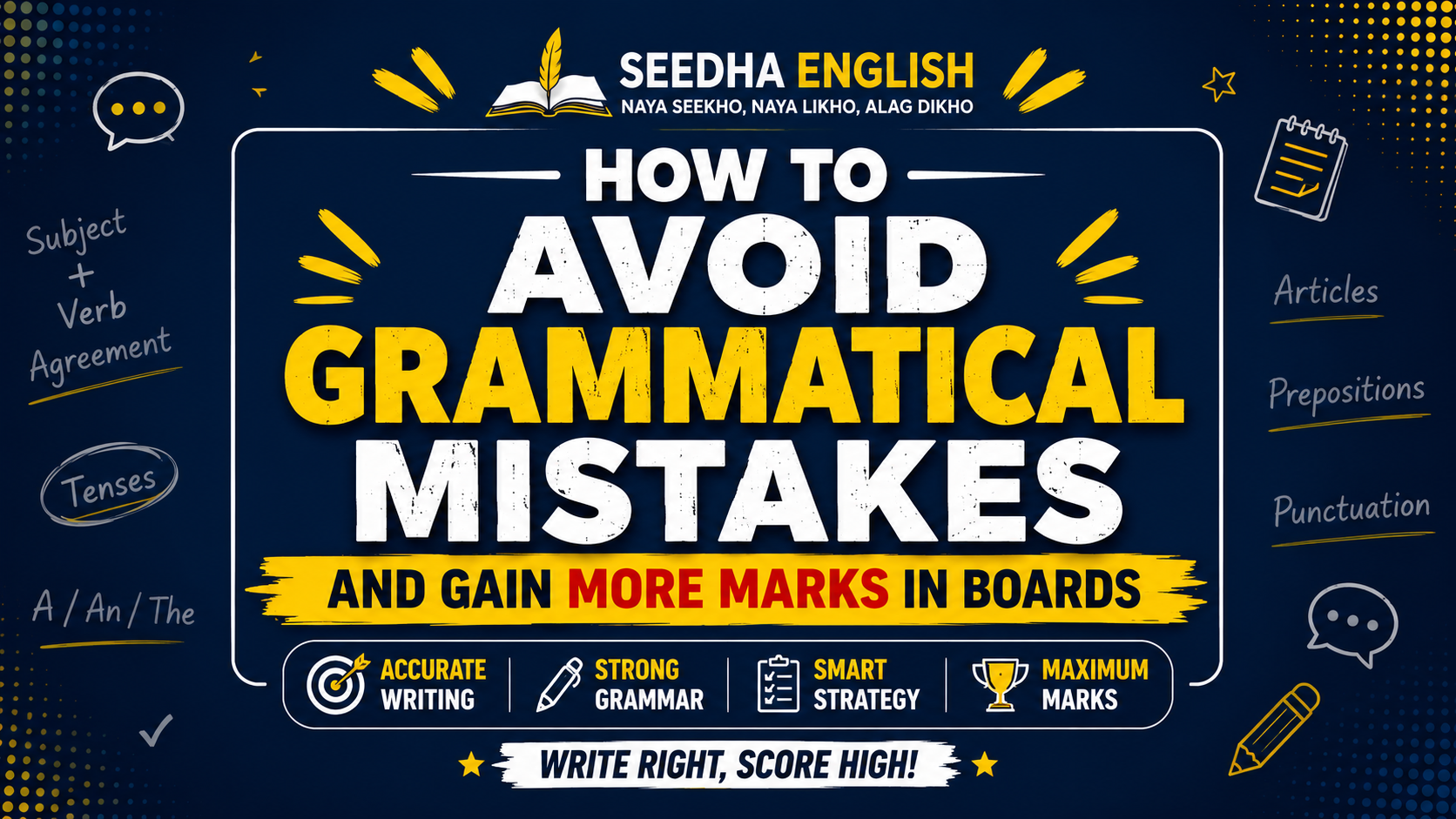
How to Avoid Grammatical Mistakes and Gain More Marks in CBSE English Boards The Evidence-Based Grammar & Writing Strategy for 90+, 95+ and 100
Most students think grammatical mistakes are “small mistakes.”
They are not.
A missing “s”, an incorrect tense, a wrong preposition, a missing article or a poorly constructed sentence may look insignificant to a student—but collectively, these errors can make an otherwise excellent answer look careless.
And there is another problem: students often practise grammar in isolation. They solve 50 error-detection questions, tick the correct answers and feel prepared. Then, in the actual examination, they write sentences such as:
❌ The poet want to conveys that nature have a healing power.
The student may know the poem perfectly. The problem is not knowledge. It is accuracy during real writing.
The solution, therefore, is not simply “study more grammar.”
It is:
LEARN → APPLY → DETECT → CORRECT → REWRITE → RETRIEVE
That is the system this article develops.
🎯 First: Understand Exactly Where Grammar Matters in CBSE English
For CBSE Class XII English Core 2026–27, the official curriculum gives 18 marks to Creative Writing Skills. Importantly, accuracy of spelling and grammar is explicitly assessed in each writing task:
Notice — 1 mark for accuracy Invitation/Reply — 1 mark for accuracy Letter — 1 mark for accuracy Article/Report — 1 mark for accuracy
That makes 4 marks directly tied to spelling and grammatical accuracy within the writing section.
But don't make the mistake of thinking:
“So grammar is worth only four marks.”
The bigger issue is language quality throughout your written paper. Even when grammar is not a separately labelled marking criterion, errors affect clarity, precision and the overall quality of expression.
So the target should not be:
“I need to save 4 grammar marks.”
It should be:
“I want every sentence I write to be accurate.”
That is the mindset of a 95+ student.
🔥 THE BIGGEST MYTH: “DIFFICULT ENGLISH = MORE MARKS”
No.
The board examiner does not need you to sound like a Victorian novelist.
Consider these two sentences:
Student A:
The poet's utilisation of natural imagery manifests an exceptionally profound philosophical contemplation concerning the transient yet perpetually regenerative dimensions of existence.
Student B:
The poet uses natural imagery to present the contrast between transience and renewal.
Which one is safer?
Student B.
It is:
precise readable grammatically controlled directly connected to the question less likely to contain an error Remember this formula: ACCURATE + RELEVANT + CLEAR > COMPLICATED + IMPRESSIVE-SOUNDING
Your objective is not to prove that you know difficult vocabulary.
Your objective is to communicate your idea without grammatical friction.
🧠 WHAT ACTUALLY WORKS? DON'T JUST STUDY RULES.
This is where evidence becomes useful.
Research on adolescent writing has found stronger effects for approaches such as strategy instruction, summarisation, peer assistance and sentence combining than for isolated formal grammar instruction. A major meta-analysis of writing instruction covering Grades 4–12 reported a moderate positive effect for sentence combining and a much stronger effect for explicit writing-strategy instruction.
Another evidence review reports that sustained, explicit sentence-combining instruction can improve sentence-level writing, including sentence construction and writing accuracy, and may be more productive than traditional grammar instruction alone.
And retrieval practice is not merely a fashionable study technique: a systematic review of classroom research found benefits across different educational settings and subjects, while research with EFL learners found that retrieval practice combined with feedback produced better longer-term retention than repeated study alone.
So what does that mean for a CBSE student?
Don't spend two hours merely reading:
“Rules of Subject–Verb Agreement.”
Instead:
Learn the rule → write sentences → make mistakes → receive feedback → correct them → retrieve the rule later → apply it again.
That is far more powerful.
PART 1 — IDENTIFY YOUR PERSONAL GRAMMAR ENEMIES
Every student has different recurring errors.
One student constantly writes:
He go...
Another writes:
One of the reason...
Another writes:
Since two years...
Another knows grammar but makes errors because they write too quickly.
Therefore, don't create a generic list called:
“My Grammar Rules”
Create:
MY TOP 10 REPEATED MISTAKES
For example:
Mistake I Make Correct Form Rule He go He goes S-V agreement One of the reason One of the reasons One of + plural noun Since two years For two years Duration = for She don't She doesn't Singular subject Discuss about Discuss No unnecessary “about” An university A university Sound begins with /yu/ The poet want The poet wants Singular subject People is People are Plural noun He did not went He did not go Did + base verb More better Better Avoid double comparison
This notebook is much more valuable than a notebook containing 100 pages of rules you never apply.
🚨 THE 15 GRAMMATICAL ERRORS BOARD STUDENTS MUST CONTROL
- Subject–Verb Agreement
❌
The poet explain the importance of nature.
✅
The poet explains the importance of nature.
Another common error:
❌ The characters of the story represents different attitudes.
✅ The characters of the story represent different attitudes.
Strategy:
Underline mentally:
SUBJECT → VERB
Then ask:
Singular or plural?
- “ONE OF” ERROR
One of the most common examination mistakes.
❌
One of the most important reason is...
✅
One of the most important reasons is...
Because:
one of + plural noun
More examples:
❌ One of the major problem... ✅ One of the major problems...
❌ One of the best example... ✅ One of the best examples...
- DID + WRONG VERB
Students often write:
❌
He did not understood the situation.
✅
He did not understand the situation.
Why?
Because:
did + base form
Therefore:
did not go did not understand did not realise did not know
Not:
did not went ❌ did not understood ❌ did not realised ❌
- DO/DOES + WRONG VERB
❌
She does not understands the situation.
✅
She does not understand the situation.
Remember:
does + base verb
- HAS/HAVE
❌
The students has completed the task.
✅
The students have completed the task.
But:
The student has completed the task.
A useful mental check:
student → has students → have
- TENSE SHIFTING
Suppose you are analysing a poem.
❌
The poet presents nature as beautiful and then suggested that it heals the human mind.
You have shifted unnecessarily.
✅
The poet presents nature as beautiful and suggests that it heals the human mind.
For literary analysis, maintaining the literary present is usually a clean and effective convention.
- SINCE vs FOR
This is a classic.
SINCE = starting point
since Monday since 2020 since morning
FOR = duration
for two hours for five years for a long time
❌
She has been studying since three hours.
✅
She has been studying for three hours.
- ARTICLE ERRORS
❌
He is honest man.
✅
He is an honest man.
But don't automatically add the everywhere.
❌
The education is important.
Better:
Education is important.
The exact choice depends on whether you mean something generally or specifically.
- A vs AN — SOUND MATTERS
Students often memorise:
A before consonant AN before vowel
That shortcut is incomplete.
The choice is based on sound, not merely spelling.
Correct:
an honest man an hour a university a European country
Why?
Because honest begins with a vowel sound, while university begins with a /yu/ sound.
- PREPOSITIONS
These small words cause huge problems.
❌
He is good in English.
✅
He is good at English.
❌
She is interested on literature.
✅
She is interested in literature.
❌
He discussed about the issue.
✅
He discussed the issue.
Don't translate prepositions mechanically from Hindi.
Learn common word + preposition combinations as units:
interested in good at responsible for depend on focus on aware of different from
- PRONOUN REFERENCE
A sentence should make it obvious what he, she, it, they, this, that refers to.
Weak:
Ravi spoke to Mohan after he finished the assignment.
Who finished it?
Ravi or Mohan?
Better:
After Ravi finished the assignment, he spoke to Mohan.
Board principle: Never make the examiner guess your meaning.
- PLURALISATION
❌
These type of questions are difficult.
✅
These types of questions are difficult.
Or:
This type of question is difficult.
Notice how both parts agree.
- ADJECTIVE vs NOUN
❌
The character shows great courageous.
✅
The character shows great courage.
Or:
The character is extremely courageous.
Know the word family:
courage → courageous → courageously
beauty → beautiful → beautifully
significance → significant → significantly
- SPELLING
Grammar and spelling are different—but CBSE explicitly includes accuracy of spelling and grammar in the writing-task criteria.
Create a personal list of difficult words from your syllabus.
For example:
perseverance significance psychological civilisation contemporary responsibility environment extraordinary
Don't simply read them.
Use this method:
LOOK → COVER → WRITE → CHECK
Write the word without looking.
If incorrect:
Write it correctly three times.
Then retrieve it the next day.
- PUNCTUATION
Don't write everything as one continuous stream.
❌
The poet presents nature as beautiful it provides happiness to human beings and therefore people should value it.
✅
The poet presents nature as beautiful. It provides happiness to human beings; therefore, people should value it.
The second version is much easier to read.
🔥 THE MOST POWERFUL STRATEGY: “ERROR → REPAIR → REPEAT”
Let's take an actual-style sentence.
First attempt:
The poet want to conveys that nature have the power to heals human beings.
There are several errors.
Step 1 — Detect
want → wants to conveys → to convey nature have → nature has to heals → to heal
Step 2 — Repair
The poet wants to convey that nature has the power to heal human beings.
Step 3 — Improve
The poet suggests that nature possesses the power to heal and comfort human beings.
Step 4 — Retrieve
Close the notebook.
Now write another sentence using:
singular subject wants to + base verb has
For example:
The poet wants to emphasise that nature has a restorative influence on the human mind.
This is learning.
Not simply reading the rule.
🧠 THE “THREE-LAYER” GRAMMAR SYSTEM
I recommend that board students practise grammar at three levels.
LEVEL 1 — SENTENCE
Can you produce a correct sentence?
The poet highlights the beauty of nature.
LEVEL 2 — PARAGRAPH
Can you maintain accuracy across several sentences?
The poet highlights the beauty of nature. He presents it as a source of joy and emotional strength. Through natural imagery, he suggests that beauty can provide lasting comfort.
LEVEL 3 — FULL ANSWER
Can you maintain:
grammar tense coherence vocabulary evidence relevance
across an entire 120-word response?
That is the real examination skill.
✍️ THE “SENTENCE COMBINING” DRILL
This is particularly useful because evidence supports sentence-combining as a productive writing practice.
Take:
The grandmother was old. She wanted to learn. She was determined.
Combine them.
Basic:
The grandmother was old, but she wanted to learn and was determined.
Better:
Although the grandmother was old, she was determined to learn.
More sophisticated:
Despite her age, the grandmother remained determined to acquire the education she had long desired.
This teaches you how to construct controlled, varied sentences rather than merely memorising grammatical definitions.
🎯 THE 20-MINUTE DAILY GRAMMAR STRATEGY
You don't need to spend three hours every day.
Try this:
⏱️ 5 minutes — RULE RETRIEVAL
Without looking at your notebook, write:
2 subject–verb rules 2 tense rules 2 article rules 2 preposition combinations ⏱️ 5 minutes — ERROR CORRECTION
Take 5 incorrect sentences.
Correct them.
Then explain why each correction is necessary.
⏱️ 5 minutes — SENTENCE PRODUCTION
Write five original sentences using the rules.
⏱️ 5 minutes — EXAM APPLICATION
Take one CBSE-style literature/writing question and write a short response.
Then check your grammar.
Total: 20 MINUTES
But do it consistently.
📈 THE “10 ANSWERS, NOT 100 RULES” RULE
Here's a major change I would make in a student's preparation.
Instead of saying:
“I will finish 10 grammar chapters.”
Say:
“I will write and analyse 10 complete answers.”
Why?
Because your examination doesn't ask:
“Define subject–verb agreement.”
It asks you to communicate.
Grammar must therefore move from:
Knowledge → Performance
📝 THE GRAMMAR AUDIT
After every practice paper, don't merely calculate your marks.
Perform a Grammar Audit.
Take your paper and mark every error.
Then classify it:
SVA
Subject–Verb Agreement
T
Tense
ART
Articles
PREP
Preposition
PRON
Pronoun
SPELL
Spelling
PUNC
Punctuation
VOC
Word choice
Now count.
For example:
Error Type Frequency Subject–Verb 6 Articles 3 Tense 4 Prepositions 2 Spelling 5 Punctuation 1
Your next week's preparation should focus primarily on:
Subject–Verb + Spelling + Tense
This is much more intelligent than randomly studying grammar.
🚀 THE “ERROR RATE” METHOD
Here's a strategy you can actually measure.
Suppose you write 200 words.
You find:
10 language errors.
Your approximate error frequency is:
5 errors per 100 words
Don't be satisfied with “I got better.”
Measure it.
Week 1:
10 errors / 200 words
Week 2:
7 errors / 200 words
Week 3:
5 errors / 200 words
Week 4:
3 errors / 200 words
Now you have evidence of improvement.
The exact target will differ by student, but the principle is powerful:
WHAT YOU MEASURE, YOU CAN IMPROVE. 🧪 CREATE A “BEFORE vs AFTER” FILE
Every student should maintain examples of their own improvement.
BEFORE
The poet want to tell us that nature are beautiful and it give happiness to human being.
AFTER
The poet suggests that nature is beautiful and provides happiness to human beings.
Now compare:
Before: 5+ problems After: controlled sentence
Do this with 20–30 of your own sentences.
Eventually, you'll start recognising your typical mistakes before the teacher points them out.
🔄 THE 24-HOUR CORRECTION RULE
Here's an extremely useful practice strategy.
Whenever a teacher marks an error:
Don't simply correct it immediately.
Instead:
Day 1: Teacher marks error ↓ You understand correction ↓ You write the correct sentence ↓ Next day: Try to reproduce the rule without looking ↓ Three days later: Use the structure in a new sentence ↓ One week later: Test yourself again
This combines feedback with retrieval, both of which are supported by learning research.
🏆 THE 7-DAY GRAMMAR REPAIR PROGRAMME DAY 1 — SUBJECT–VERB AGREEMENT
Practise:
is/are was/were has/have does/do singular/plural nouns
Write 20 sentences.
DAY 2 — TENSES
Practise:
present past present perfect past perfect literary present
Then write one literature answer.
DAY 3 — ARTICLES
Practise:
a an the zero article
Use examples from your own writing.
DAY 4 — PREPOSITIONS
Create 30 common combinations.
interested in responsible for dependent on aware of good at
DAY 5 — SENTENCE STRUCTURE
Practise:
simple sentences compound sentences complex sentences sentence combining DAY 6 — SPELLING + PUNCTUATION
Use your own error list.
Not someone else's.
DAY 7 — FULL WRITING TEST
Write:
one notice/invitation one letter one article/report one literature answer
Then conduct a complete grammar audit.
🔥 THE “EXAMINER'S EYES” TECHNIQUE
After writing an answer, stop being the student.
Become the examiner.
Read your answer and ask:
1.
Can I understand the point immediately?
2.
Is every sentence complete?
3.
Does every subject agree with its verb?
4.
Have I shifted tense unnecessarily?
5.
Have I used the correct articles?
6.
Are my prepositions natural?
7.
Are my spellings correct?
8.
Have I repeated the same word excessively?
9.
Is my punctuation helping the reader?
10.
Does this actually answer the question?
This final question is crucial.
Because:
A grammatically perfect irrelevant answer is still a poor answer. 📖 APPLY THE STRATEGY TO CBSE WRITING TASKS
The current CBSE Class XII English Core curriculum specifically assesses accuracy of spelling and grammar in Notice, Invitation/Reply, Letter, and Article/Report.
So create separate accuracy checklists.
NOTICE — FINAL CHECK
Before moving on:
☐ Correct heading ☐ Date ☐ Relevant information ☐ Appropriate tone ☐ Word limit ☐ Spelling ☐ Subject–verb agreement ☐ Punctuation
LETTER — FINAL CHECK
Ask:
Did I maintain formal language?
Check:
☐ tense ☐ articles ☐ prepositions ☐ sentence structure ☐ punctuation ☐ spelling ☐ unnecessary repetition
ARTICLE/REPORT — FINAL CHECK
Check:
☐ Introduction ☐ Organisation ☐ Logical progression ☐ Appropriate vocabulary ☐ Accurate grammar ☐ Correct tense ☐ Subject–verb agreement ☐ Word limit
⚠️ THE FIVE MISTAKES YOU SHOULD NEVER MAKE IN THE LAST 10 MINUTES
If you have limited revision time, look specifically for:
- is/are
- has/have
- do/does
- did + base verb
- singular/plural nouns
Then check:
- spelling
- punctuation
- tense consistency
These quick checks can catch a surprising number of avoidable errors.
🧠 THE GOLDEN RULE OF BOARD ENGLISH
Don't ask:
“How can I write more sophisticated English?”
Ask:
“How can I express my idea more accurately?”
That one change in thinking can transform your writing.
💯 THE 95+ STUDENT'S GRAMMAR SYSTEM
A high-scoring student does not depend on luck.
They develop a system:
- KNOW
Understand the grammar rule.
- NOTICE
Identify the rule in real sentences.
- APPLY
Use it in their own writing.
- AUDIT
Find their mistakes.
- REPAIR
Correct them.
- RETRIEVE
Recall the rule later without looking.
- REAPPLY
Use it again in a new answer.
And then:
REPEAT. 🔥 THE FINAL “SEEDHA” FORMULA
If you want to remember the entire article in one framework, remember:
R.E.A.D. R — Recognise
Identify your recurring grammatical mistakes.
E — Explain
Understand why the sentence is wrong.
A — Apply
Use the correct structure in your own writing.
D — Detect Again
Test yourself later and see whether the mistake returns.
This is much more powerful than:
Read grammar → memorise grammar → forget grammar.
🏁 FINAL WORD
Scoring high in English does not require you to write extraordinarily difficult English.
It requires you to write extraordinarily controlled English.
A student who writes:
The poet wants to convey that nature provides emotional comfort.
is often in a much safer position than a student who attempts:
The poet's philosophical conceptualisation of nature symbolises an emotionally transcendental manifestation of human existence.
The first student has control.
And in a board examination, control matters.
So don't prepare grammar merely by solving grammar exercises.
Write. Make mistakes. Analyse them. Correct them. Rewrite them. Retrieve the rule. Apply it again.
That is how grammatical accuracy becomes automatic.
And when your content is strong, your analysis is relevant, your presentation is disciplined and your language is accurate, you are no longer merely attempting an English paper.
You are maximising every mark available to you.
🚀 SEEDHA ENGLISH
At SEEDHA ENGLISH, our approach is simple:
Don't memorise blindly. Understand deeply. Don't write unnecessarily. Write precisely. Don't ignore mistakes. Analyse them. Don't practise randomly. Practise strategically.
LEARN THE RULE. MASTER THE SENTENCE. CONTROL THE ANSWER. MAXIMISE THE MARKS. SEEDHA PADHO. SEEDHA LIKHO. SEEDHA MARKS LAO.
The CBSE-specific points above are aligned with the official 2026–27 English Core curriculum; always cross-check the latest CBSE curriculum and sample assessment material before the examination.