Exam Strategy
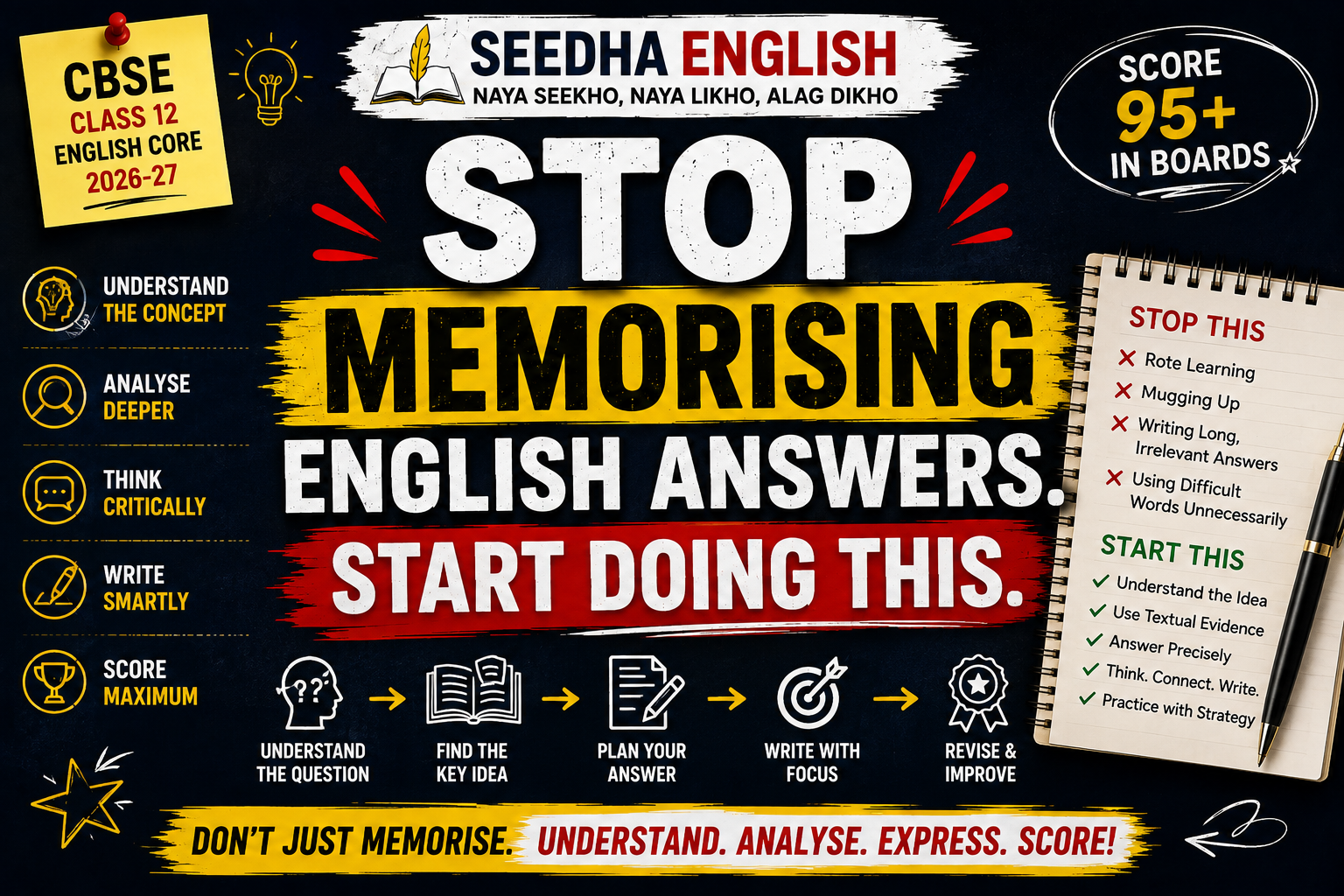
Stop Memorising English Answers. Start Doing This.
Stop Memorising English Answers. Start Doing This. The Smarter Way to Prepare for CBSE English Boards and Score 95+

Stop Memorising English Answers. Start Doing This. The Smarter Way to Prepare for CBSE English Boards and Score 95+
For years, students have been taught a simple formula for English examinations:
Read the chapter → memorise important answers → reproduce them in the examination → score marks.
It may work for a few predictable questions. But it becomes a serious problem when the question is competency-based, analytical, inferential, or framed differently from the textbook exercises.
And this is exactly where many students who have memorised dozens of answers suddenly struggle.
The solution is not to memorise more. The solution is to understand better, think better and write better.
For CBSE Class XII English Core 2026–27, the paper assesses reading comprehension, interpretation, analysis, inference and evaluation in Reading Skills, while Literature carries 40 marks and Creative Writing carries 18 marks.
So if your preparation strategy is still “mug up 30 answers from every chapter”, it is time to change it.
- The Biggest Mistake: Preparing Questions Instead of Preparing the Chapter
Suppose you have memorised:
“How did the peddler change at the end of the story?”
You may reproduce your prepared answer perfectly.
But what if the examination asks:
Why was Edla more influential than the circumstances surrounding the peddler? How does the story challenge the assumption that people are permanently defined by their past? What role does kindness play in the peddler's transformation? If Edla had treated him with suspicion, would his transformation still have occurred?
These questions may not look identical to what you memorised.
But notice something important:
They are testing the same underlying concepts.
Therefore, the student who memorised an answer may panic.
The student who understood the chapter can respond.
That is the difference between:
Answer Preparation and Concept Preparation.
- Don't Memorise Answers. Build a “Chapter Intelligence Sheet”
Instead of preparing 15–20 long answers for every chapter, reduce the entire chapter to its intellectual structure.
For every prose chapter, prepare these 10 elements:
- Central Idea
What is the chapter fundamentally saying?
- Major Themes
What larger ideas does the chapter explore?
- Characters
Who are the important characters and what do they represent?
- Character Transformation
Does anyone change? Why? How?
- Important Incidents
Which incidents actually drive the story?
- Cause and Effect
What happened because of what?
- Author's Purpose
Why did the writer present the situation in this particular manner?
- Textual Evidence
Which incidents, descriptions or statements support your interpretation?
- Contemporary Connection
Can the idea be connected to society, human behaviour or modern life?
- Possible Questions
What WHY, HOW, WHAT IF, COMPARE and ANALYSE questions can emerge?
Once you understand these ten things, you don't need to memorise every possible question.
You can generate the answer yourself.
- Replace “Question → Answer” With “Question → Idea → Evidence → Explanation”
This is one of the most important changes you can make.
Most students follow:
Question → Memorised Paragraph
Instead, follow:
Question → Identify the demand → Recall the concept → Select evidence → Explain → Conclude
For example:
Question:
How does the behaviour of a character contribute to the development of the story?
Don't immediately search your memory for a paragraph.
Ask:
What is the question actually asking?
It requires:
character behaviour its significance connection with the plot explanation
Now retrieve the relevant incident.
Then construct the answer.
This makes your answer flexible.
- Learn the “WHY” Behind Every Important Incident
One of the easiest ways to move from average preparation to high-level preparation is to stop asking only:
What happened?
Start asking:
Why did it happen?
And then:
Why did the author make it happen this way?
For example:
Level 1 — Recall
What happened?
Level 2 — Understanding
Why did it happen?
Level 3 — Analysis
What does it reveal?
Level 4 — Evaluation
Why is this significant?
Level 5 — Application
How can this idea be connected to another situation?
That is where real competency develops.
- Use the P-E-E-L Method While Writing
A strong literature answer should not simply contain information.
It should contain reasoning.
A useful structure is:
P — Point
Directly answer the question.
E — Evidence
Refer to a relevant incident, detail or textual element.
E — Explanation
Explain how the evidence proves your point.
L — Link
Connect the explanation back to the question.
For example:
Point: The character's transformation is primarily caused by the experience of genuine compassion.
Evidence: The character receives kindness when he expects suspicion and rejection.
Explanation: This unexpected treatment challenges his existing perception of human beings and creates the possibility of moral change.
Link: Therefore, the character's transformation demonstrates the power of empathy to influence human behaviour.
Notice what happened here.
The answer wasn't dependent on memorising a paragraph.
It was constructed through thinking.
- For Poetry, Don't Memorise Device Lists
Another common mistake is:
“This poem has metaphor, imagery, personification, alliteration…”
But simply identifying a literary device does not demonstrate understanding.
Instead use:
DEVICE → EXAMPLE → EFFECT → MEANING
Ask four questions:
What device is being used?
Identify it.
Where is it used?
Refer to the relevant expression.
What effect does it create?
Explain its impact.
Why is it important?
Connect it to the poet's larger idea.
For instance, don't stop at:
“The poet uses personification.”
Write:
The personification gives the natural element a human-like presence, making the poet's abstract idea more vivid and emotionally accessible.
That is analysis.
- Stop Learning “Fancy Words” Just to Sound Intelligent
This is another misconception.
Many students believe:
Difficult English = Better Marks.
Not necessarily.
An answer filled with complicated vocabulary but lacking clarity is weaker than a simple, precise and well-reasoned response.
Instead of:
“The protagonist undergoes a profound psychological metamorphosis consequent upon the unprecedented manifestation of benevolence…”
Write:
“The protagonist undergoes a significant psychological change because he experiences unexpected kindness.”
The second sentence is:
clearer more natural easier to understand more precise
Your objective is not to impress the examiner with vocabulary.
Your objective is to communicate your interpretation effectively.
- Read the Question Like an Examiner
Before answering, identify the command word.
Words such as:
Explain Analyse Discuss Examine Justify Compare Evaluate Interpret Comment How Why
are not interchangeable.
“Explain”
Tell the meaning and reasoning.
“Analyse”
Break the idea into parts and establish relationships.
“Compare”
Identify similarities and/or differences.
“Justify”
Make a claim and support it with evidence.
“Evaluate”
Make a judgement based on reasoning.
“Why”
Give causes and reasoning.
“How”
Explain the process, method or manner.
A student can know the chapter completely and still lose marks by answering the wrong demand of the question.
- The “What If?” Technique
This is one of the best ways to prepare for competency-based questions.
After studying an important incident, ask:
What if this incident had not happened?
Then ask:
What would change?
Then:
What does this tell us about the author's construction of the story?
For example:
Incident → What if it were removed? → Consequence → Significance
This develops analytical thinking instead of rote learning.
- Use the “5 Question Drill” After Every Chapter
Once you've completed a chapter, don't immediately memorise answers.
Take a blank page and write:
- WHY?
Why did the important events happen?
- HOW?
How did the events affect the characters/theme?
- WHAT IF?
What could have happened differently?
- SO WHAT?
Why is the central idea significant?
- CONNECTION?
How does the chapter connect with real life or a contemporary issue?
If you can answer these five questions without looking at your notes, your understanding is becoming examination-ready.
- Your Notes Should Not Contain Only Answers
A high-quality English notebook should contain thinking material.
For each chapter, create a page like this:
Area What to Prepare Central Idea 2–3 lines Themes 3–5 major themes Characters Traits + evidence Important Incidents 5–7 Character Change Cause → Change → Result Literary Devices Device + effect Vocabulary Important contextual words Author's Purpose Why the text was written Textual Evidence Key incidents/details Competency Questions WHY/HOW/WHAT IF Possible Comparisons Related ideas/texts Answer Framework 3–5 key points
This is far more useful than maintaining a notebook containing 50 memorised paragraphs.
- Practice Writing Without Looking at the Answer
This is where most students fail.
They read:
Question → Answer → “Yes, I know this.”
But recognition is not the same as retrieval.
Instead:
Step 1
Read the question.
Step 2
Close your book.
Step 3
Write the answer from memory.
Step 4
Compare it with your notes.
Step 5
Identify missing ideas.
Step 6
Rewrite the weak portions.
Step 7
Attempt a different question on the same concept.
This transforms passive reading into active preparation.
- The “Same Concept, Different Question” Test
This is perhaps the most powerful test you can give yourself.
Suppose you've prepared:
“How does kindness transform the character?”
Now create five variations:
How does compassion influence the character's behaviour? Why does the character's perception of humanity change? What role does kindness play in the character's transformation? How does the author's portrayal of compassion contribute to the theme? What might have happened if the character had not received kindness?
If you can answer all five without memorising five different paragraphs, you understand the concept.
- Don't Ignore Reading Skills
Students sometimes focus almost entirely on Literature because they believe English is mainly about chapters.
That is a mistake.
The current CBSE Class XII English Core syllabus allocates 22 marks to Reading Skills, including an unseen passage and a case-based factual passage. The questions assess comprehension, interpretation, analysis, inference and evaluation, along with vocabulary through inference.
Therefore, reading practice is not about memorising anything.
You have to develop the ability to:
Read → Locate → Interpret → Infer → Evaluate → Answer
That's another reason why rote learning alone cannot guarantee a high score.
- Writing Skills Also Reward Precision
Creative Writing carries 18 marks in the current Class XII English Core structure. Notice and Invitation/Reply are assessed for format, content and accuracy, while longer writing tasks also assess organisation of ideas.
This means your preparation should not simply involve memorising:
“This is the format.”
You must also learn:
how to interpret the situation how to select relevant information how to maintain appropriate tone how to organise ideas how to stay within the required word limit how to eliminate grammatical and spelling errors
For example, the current syllabus explicitly assigns 1 mark for accuracy of spelling and grammar in each of the four writing tasks.
So accuracy is not decoration.
Accuracy is part of the marking.
- Your Final Revision Should Be Concept-Based
During the final days before the examination, don't attempt to reread every answer repeatedly.
Instead revise:
Literature
Theme → Character → Incident → Evidence → Interpretation
Poetry
Idea → Image → Device → Effect → Message
Reading
Inference → Vocabulary → Analysis → Evaluation
Writing
Format → Content → Organisation → Accuracy
This makes revision significantly more efficient.
- The 7-Day “Stop Memorising” Challenge
Try this for one week.
Day 1 — Understand
Choose one chapter and identify its central idea and themes.
Day 2 — Analyse
Study characters, incidents and cause-effect relationships.
Day 3 — Evidence
Collect important textual details and examples.
Day 4 — Question
Create WHY, HOW, WHAT IF and EVALUATE questions.
Day 5 — Write
Attempt answers without looking at notes.
Day 6 — Review
Compare your responses with your study material and identify weaknesses.
Day 7 — Retrieve
Attempt new questions on the same chapter.
If you can do this honestly, you will notice something important:
You stop depending on the exact wording of the question.
- What High-Scoring Students Actually Do Differently
A topper is not necessarily the student who has memorised the largest number of pages.
A strong student is usually able to:
Understand → Recall → Connect → Analyse → Express
A weak strategy is:
Read → Memorise → Forget → Panic
A stronger strategy is:
Understand → Practise → Retrieve → Analyse → Write → Correct → Rewrite
That difference becomes extremely important when questions demand interpretation rather than reproduction.
- The New English Preparation Formula
Forget:
MUG UP → REPRODUCE → HOPE FOR MARKS
Adopt:
UNDERSTAND → ANALYSE → CONNECT → RETRIEVE → WRITE → REVIEW
Or, even more simply:
LEARN → APPLY → DETECT → CORRECT → REWRITE → RETRIEVE
This is the cycle that turns knowledge into examination performance.
- The Final Rule: Don't Prepare for Questions. Prepare for Possibilities.
You cannot predict the exact wording of the question.
But you can prepare yourself to handle different wordings of the same idea.
You cannot memorise every possible competency-based question.
But you can understand the chapter deeply enough to construct an answer.
You cannot control exactly how the examiner frames the question.
But you can control how clearly you interpret, analyse and respond to it.
That is the real objective of English preparation.
Final Message to Students
If you are preparing for CBSE English Boards, don't ask yourself:
“How many answers have I memorised?”
Ask:
“How many concepts can I explain without looking at my notes?”
Don't ask:
“Can I reproduce this paragraph?”
Ask:
“Can I answer the same idea if the question is framed differently?”
Don't ask:
“How many pages can I write?”
Ask:
“How precisely can I answer what has actually been asked?”
Because ultimately:
English is not a memory test. It is a test of understanding, interpretation and expression.
And that is why the smarter approach is:
DON'T JUST MEMORISE. UNDERSTAND. ANALYSE. EXPRESS. SCORE.
SEEDHA ENGLISH by SEEDHA EDUCATION
SEEDHA PADHO. SEEDHA LIKHO. SEEDHA MARKS LAO.