Exam Strategy
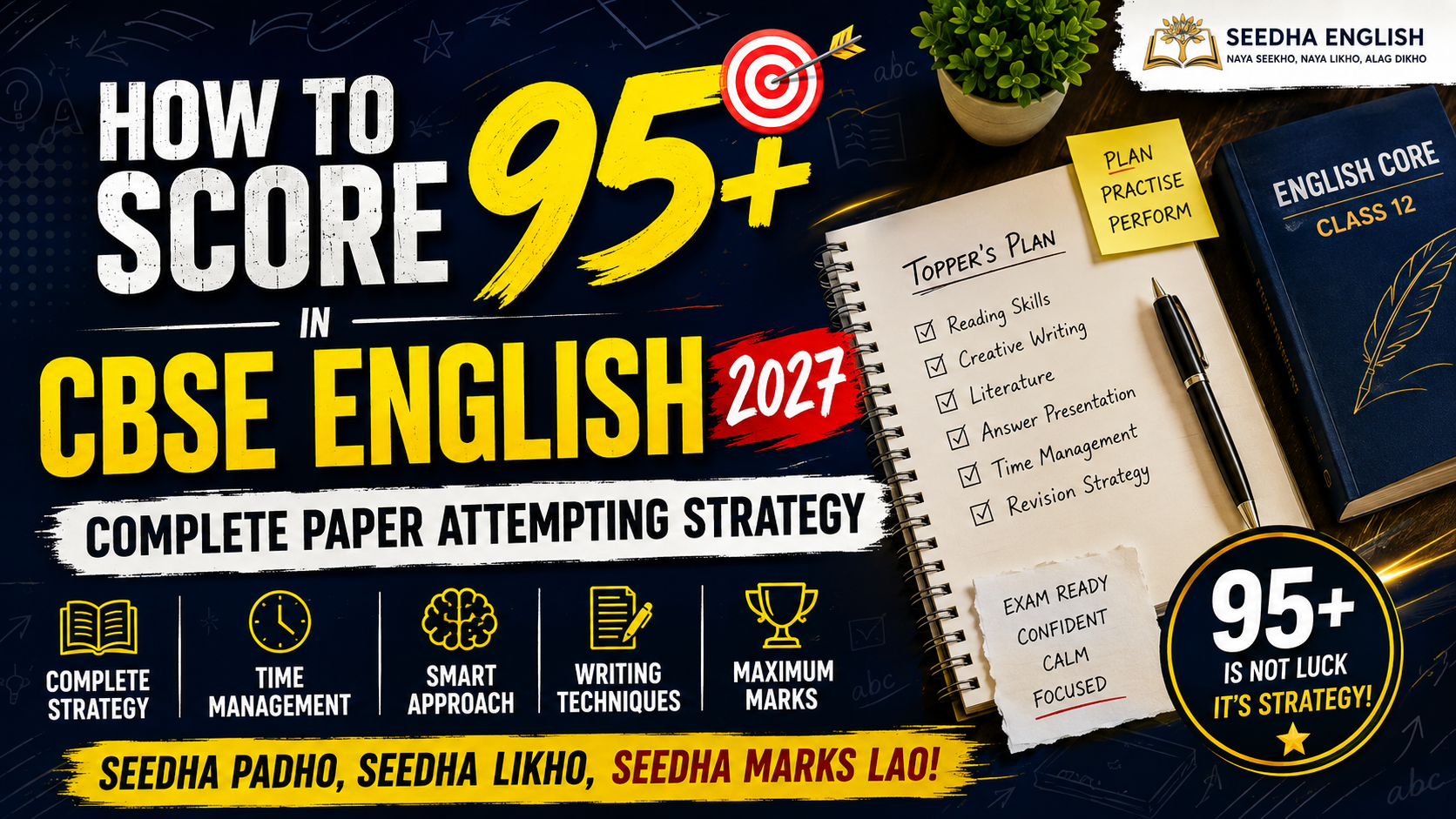
How to Score 95+ in CBSE English 2027 🔥| Complete Paper Attempting Strategy
How to Score 95+ in CBSE English 2027 🔥 Learn the complete paper-attempting strategy to maximise your marks. From Reading and Writing to Literature, discover time management, answer presentation, competency-based questions, scoring techniques, common mistakes, and topper strategies. Follow this blueprint, practise smartly, and enter the exam with confidence. SEEDHA PADHO, SEEDHA LIKHO, SEEDHA MAR

How to Score 95+ in CBSE English 2027 🔥| Complete Paper Attempting Strategy
📘 THE SEEDHA EDUCATION MASTER PLAN How to Attempt the CBSE Class 12 English Core Paper & Maximise Your Score
“Seedha Padho. Seedha Likho. Seedha Marks Lao.”
Scoring high in CBSE English Core is not about writing the longest answers. It is about understanding the question, selecting the right evidence, organising your ideas and presenting them in a way that makes evaluation easy.
For Session 2026–27, CBSE English Core theory is structured around Reading Skills (22 marks), Creative Writing Skills (18 marks), and Literature (40 marks). The paper assesses not only recall but also comprehension, inference, analysis, evaluation and application.
🎯 STEP 1 — KNOW WHERE YOUR MARKS COME FROM Section Marks Your Target 📖 Reading Skills 22 20–22 ✍️ Creative Writing 18 17–18 📚 Literature 40 36–40 Theory 80 73–80
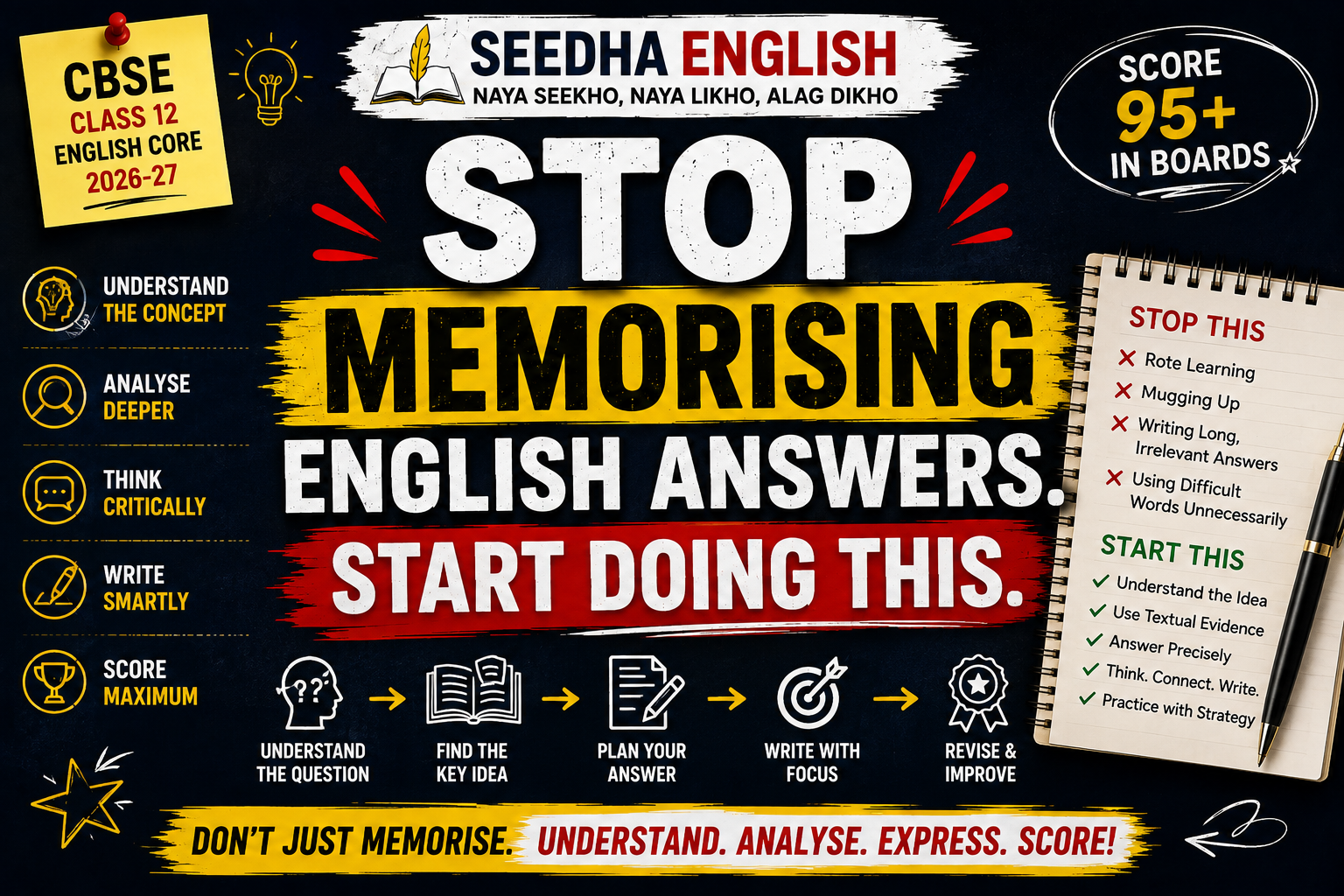
Golden Rule: Don't prepare English as a subject where you simply memorise answers. Prepare it as a skill-based paper.
⏱️ STEP 2 — THE 3-HOUR TIME PLAN
Don't enter the examination hall without a time strategy.
Recommended allocation
Reading — 45 minutes Writing — 40 minutes Literature — 85 minutes Revision — 10 minutes
Keep approximately 20–25 minutes as a flexible buffer because some questions may require more thought.
The most important rule:
Don't allow one difficult question to consume the time of three easy questions.
If you are stuck, mark it, move ahead and return later.
📖 STEP 3 — READING COMPREHENSION: DON'T READ LIKE A STORY
The two passages together carry 22 marks, and CBSE specifically assesses comprehension, interpretation, analysis, inference and evaluation.
Use the Q → Locate → Understand → Answer method. Before answering: Read the question carefully. Identify its keyword. Locate the relevant portion of the passage. Read a few lines before and after it. Understand the context. Write only what the question demands. For inference questions:
Don't copy a sentence blindly.
Ask:
“What does the writer actually imply?”
For vocabulary:
Don't automatically select the dictionary meaning.
Choose the meaning that fits the context of the passage.
For 40–50 word answers:
Use:
Point → Explanation → Evidence/Inference
Avoid unnecessary introduction.
✍️ STEP 4 — CREATIVE WRITING: FORMAT + CONTENT + ACCURACY
This section carries 18 marks. CBSE's 2026–27 syllabus includes Notice, Invitation/Reply, Letter and Article/Report writing.
Your writing answer should be:
Correct + Relevant + Organised + Concise
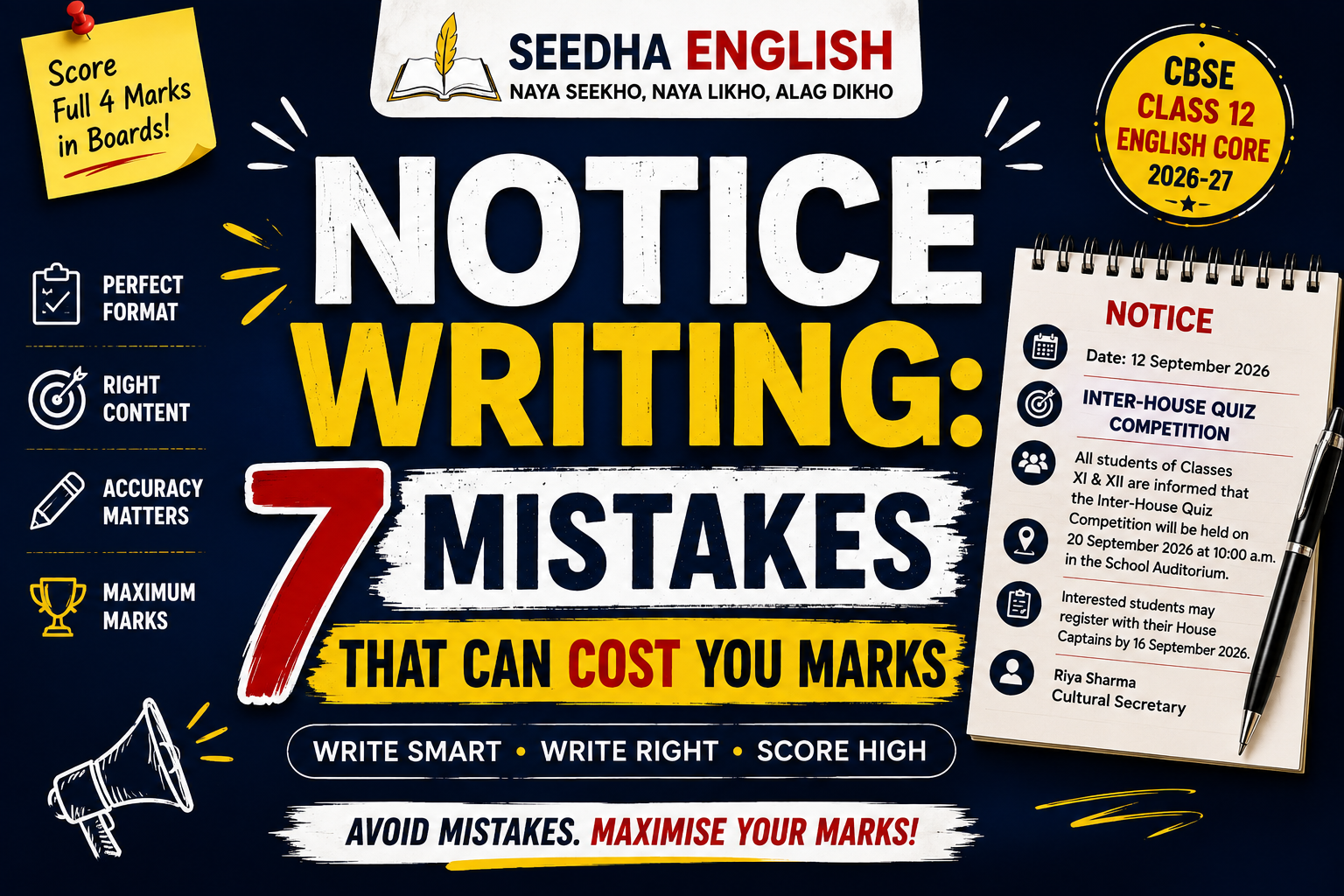
📝 Notice — 4 marks
Remember:
Heading → Date → Purpose → Essential Details → Authority/Signature
Don't turn a notice into an essay.
💌 Invitation/Reply — 4 marks
First identify:
Formal or informal? Invitation or reply? Who is inviting? What is the occasion? Date, time and venue?
Then follow the appropriate format.
📩 Letter — 5 marks
For a letter, think:
Purpose → Issue → Details → Suggestions/Request → Conclusion
CBSE awards marks for format, organisation, content and accuracy, so beautiful vocabulary cannot compensate for missing content or poor organisation.
📰 Article/Report — 5 marks
Use:
Title → Introduction → Development → Analysis/Details → Conclusion
Don't write everything you know.
Write what the given input requires.
📚 STEP 5 — LITERATURE: STOP MEMORISING PARAGRAPHS
This is where many students lose marks.
Don't memorise:
“The character was very good because…”
Instead, build a Chapter Intelligence Sheet for every prose chapter and poem.
For every chapter, prepare:
- Central idea
What is the text fundamentally about?
- Themes
What larger ideas does the writer explore?
- Characters
What do they do, think and represent?
- Important incidents
Which events can be used as evidence?
- Literary devices
Especially important in poetry.
- Author's purpose
Why has the writer presented the idea this way?
- Important textual details
Names, incidents, symbols, contrasts and descriptions.
- Competency connections
What can you infer beyond the obvious?
🧠 STEP 6 — THE 4-LAYER ANSWER METHOD
For literature answers, especially analytical questions, use:
P — Point
Directly answer the question.
E — Evidence
Refer to the relevant incident, image, character, situation or textual detail.
E — Explanation
Explain how that evidence proves your point.
L — Link
Connect it back to the question/theme.
Example structure:
The character's decision reflects his growing awareness of responsibility. This becomes evident when ________. The incident demonstrates ________, suggesting that ________. Therefore, the episode becomes significant because ________.
This is much stronger than simply narrating the chapter.
🔥 STEP 7 — FOR COMPETENCY-BASED QUESTIONS
CBSE is not merely asking:
“What happened?”
It can ask:
“What does this reveal?” “Why is this significant?” “How does this idea apply to the given situation?” “Which statement best explains…?” “Compare the two situations.” “Do you agree? Justify.”
Therefore, while studying every chapter, ask yourself:
WHY?
Why did it happen?
HOW?
How does it affect the character/theme?
WHAT IF?
What changes if the situation changes?
SO WHAT?
Why is this important?
CONNECTION?
What larger human/social idea does it represent?
📝 STEP 8 — HOW TO WRITE A 2–3 MARK ANSWER
Don't write a huge paragraph.
Use:
Direct Answer + Supporting Detail + Explanation
Avoid:
❌ Storytelling ❌ Repeating the question ❌ Unnecessary quotations ❌ Irrelevant background
🏆 STEP 9 — HOW TO WRITE A 5–6 MARK ANSWER
Use a 3-part structure:
INTRODUCTION
Answer the central idea immediately.
BODY
Give 2–3 developed arguments supported by textual evidence.
CONCLUSION
Give a meaningful final interpretation.
A strong answer should demonstrate:
Knowledge + Understanding + Evidence + Analysis + Expression
🎭 STEP 10 — POETRY: NEVER WRITE DEVICE NAMES WITHOUT EXPLANATION
If you identify a metaphor, imagery, personification, symbolism, irony etc., don't stop there.
Write:
Device → Example → Effect → Meaning
For example:
Imagery → creates a visual picture → establishes a particular mood → strengthens the poem's central idea.
The examiner needs to see that you understand why the device has been used, not merely that you can identify it.
✨ STEP 11 — MAKE YOUR ANSWERS EXAMINER-FRIENDLY
Your answer sheet should be easy to evaluate.
Do:
✔ Write readable handwriting ✔ Maintain margins ✔ Number answers correctly ✔ Leave appropriate spacing ✔ Underline important keywords ✔ Use paragraphs ✔ Follow word limits ✔ Keep answers focused
Don't:
❌ Overdecorate ❌ Use coloured pens unnecessarily ❌ Draw irrelevant diagrams ❌ Write gigantic paragraphs ❌ Fill pages merely to increase length
Presentation should support your content—not replace it.
🚨 STEP 12 — THE BIGGEST MISTAKES THAT COST MARKS ❌ Writing memorised answers
A question may be framed differently.
❌ Retelling the chapter
Literature questions often demand interpretation, not narration.
❌ Ignoring the command word
Understand words such as:
Explain • Analyse • Discuss • Evaluate • Compare • Justify • Examine
❌ Giving unsupported opinions
If you say:
“The character is selfish.”
Show why.
❌ Writing beyond the requirement
More words ≠ more marks.
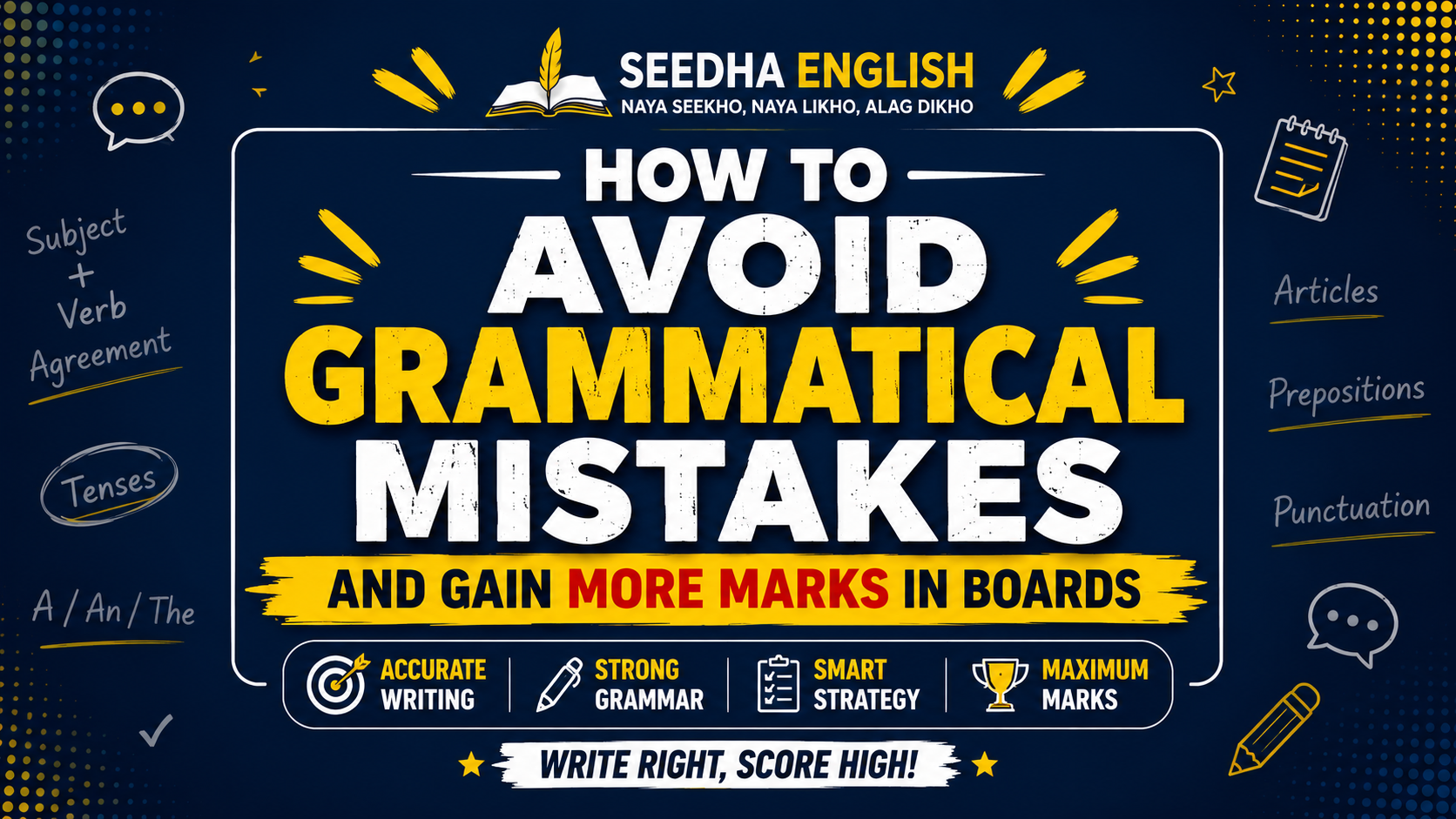
❌ Poor grammar in Creative Writing
One careless error can affect accuracy marks.
🧪 STEP 13 — THE 3-STAGE PREPARATION SYSTEM STAGE 1 — LEARN
Understand:
Chapter → Theme → Character → Incident → Evidence → Interpretation
Don't rush to memorisation.
STAGE 2 — PRACTISE
For every chapter, solve:
MCQs Extract questions Short answers Long answers Competency-based questions Comparison questions Assertion/reasoning-style questions where applicable STAGE 3 — TEST
Attempt complete papers under actual examination conditions.
After every paper, maintain an:
📊 ERROR BOOK
Create four columns:
My Mistake Why I Made It Correct Approach How I'll Avoid It
This is one of the fastest ways to convert repeated mistakes into marks.
🔁 STEP 14 — THE 7-DAY REVISION CYCLE
Instead of rereading the textbook repeatedly:
Day 1
Understand the chapter.
Day 2
Revise themes + characters + important incidents.
Day 3
Solve questions.
Day 4
Attempt competency-based questions.
Day 5
Revise mistakes.
Day 6
Attempt an extract/question set.
Day 7
Rapid revision from your notes.
Repeat the cycle.
🏅 THE 90%+ FORMULA
For a student targeting 90+ in English, the strategy should be:
NCERT understanding + CBSE pattern + PYQs + competency practice + writing practice + timed papers + error analysis
Do not chase hundreds of random questions.
Instead, master the patterns behind questions.
👑 THE 95–100 MARKS MINDSET
If your goal is 95+, don't ask:
“How can I write more?”
Ask:
“How can I make every sentence earn its place?”
Your answer should be:
Relevant. Precise. Textual. Analytical. Well-organised. Grammatically accurate.
🚀 THE FINAL EXAM-HALL CHECKLIST
Before submitting your paper, ask:
📖 Reading
☐ Did I answer according to the passage? ☐ Did I check inference questions?
✍️ Writing
☐ Correct format? ☐ Correct word limit? ☐ All required points covered? ☐ Grammar and spelling checked?
📚 Literature
☐ Did I answer exactly what was asked? ☐ Did I support my interpretation with textual evidence? ☐ Did I analyse rather than merely narrate?
📝 Presentation
☐ Correct question numbers? ☐ Legible handwriting? ☐ Important points visible? ☐ No unanswered question?
🌟 THE SEEDHA EDUCATION MANTRA
Don't study English to remember answers.
Study English to understand ideas.
Don't write more.
Write better.
Don't fear competency-based questions.
Train your mind to think beyond the obvious.
And most importantly:
SEEDHA PADHO. SEEDHA LIKHO. SEEDHA MARKS LAO.
For Session 2026–27, always align your final preparation with the latest CBSE curriculum and official assessment material rather than relying solely on older paper patterns.
— SEEDHA EDUCATION English • Commerce • Science • Socials • Complete Academic Support